
Introduction
As global brands increasingly seek sustainable and high-performance packaging alternatives, stone paper packaging has become a preferred solution for industries such as seafood export, fresh produce, cold chain logistics, and reusable shipping.
Unlike traditional corrugated cartons, stone paper packaging is manufactured using calcium carbonate (CaCO₃) and non-toxic resin, resulting in superior waterproof performance, moisture resistance, and durability.
However, for buyers sourcing stone paper boxes internationally, understanding technical specifications is essential. This guide explains the most important industry standards for stone paper packaging, including thickness, GSM, compression performance, waterproof testing, and certifications.
What Is Stone Paper Packaging?
Stone paper is a tree-free material composed primarily of:
- 70–80% calcium carbonate
- 20–30% HDPE or similar resin binders
This structure gives stone paper packaging several performance advantages:
- 100% waterproof
- Moisture resistant
- Tear resistant
- Recyclable
- Foldable and reusable
Stone paper is commonly used for:
- Seafood boxes
- Fresh produce boxes
- Frozen food packaging
- Reusable shipping boxes
- Export packaging cartons
1. Thickness Standards for Stone Paper Packaging
Thickness is one of the most critical technical specifications.
Common industry thickness standards:
| Grade | Thickness | Application |
|---|---|---|
| Lightweight board | 2 mm | Produce boxes, retail packaging |
| Standard board | 2.5–3 mm | Seafood, logistics boxes |
| Heavy-duty board | 4 mm+ | Reusable shipping & pallet packaging |
Recommended export thickness:
- Seafood packaging: 3 mm
- Fresh produce boxes: 2.5–3 mm
- Reusable shipping boxes: 3–4 mm
Thicker boards generally improve:
- compression resistance
- stacking performance
- durability during cold chain transportation
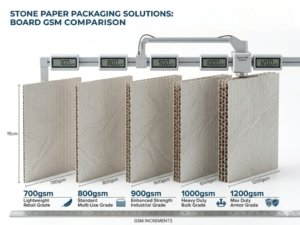
2. GSM Standards (Grams per Square Meter)
GSM measures material density and weight.
Common GSM standards in the stone paper packaging industry:
| GSM | Typical Use |
|---|---|
| 700 gsm | Light packaging |
| 800 gsm | Fruit & vegetable boxes |
| 900 gsm | Seafood export boxes |
| 1000 gsm | Heavy-duty shipping cartons |
| 1100–1200 gsm | Industrial reusable packaging |
For export packaging, common buyer requirements are:
- 850 gsm
- 900 gsm
- 1000 gsm
Higher GSM generally provides:
- better rigidity
- stronger compression strength
- improved puncture resistance
3. Compression Testing Standards
Compression strength determines stacking performance during shipping.
Key testing methods include:
Box Compression Test (BCT)
Measures vertical load capacity before collapse.
Typical performance targets:
- Standard produce boxes: 150–250 kg
- Seafood export boxes: 250–400 kg
- Heavy-duty reusable cartons: 400 kg+
Compression performance depends on:
- thickness
- GSM
- structural design
- folding pattern
4. Waterproof Testing Standards
A major advantage of stone paper packaging is water resistance.
Common waterproof test methods:
Water Immersion Test
Packaging is submerged for 24–48 hours.
Pass criteria:
- no delamination
- no softening
- no structural failure

Moisture Resistance Test
Used for cold chain and frozen logistics.
Performance benchmarks:
- humidity tolerance >95%
- no deformation under condensation
Applications:
- salmon boxes
- tuna boxes
- frozen shrimp packaging
5. Temperature Resistance Standards
Stone paper packaging is frequently used in cold chain logistics.
Typical temperature tolerance:
- Refrigerated storage: 0–4°C
- Frozen storage: -18°C to -25°C
Testing criteria:
- crack resistance after freezing
- fold endurance at low temperatures
- compression retention after thaw cycles
6. Certifications and Compliance Standards
International buyers often require compliance documentation.
Important certifications include:
Food Contact Safety
- FDA food contact compliance
- EU food packaging compliance
Environmental Certifications
Packaging Performance
- ISO 9001 quality management
- packaging durability standards
These certifications help buyers verify:
- material safety
- export compliance
- sustainability claims
How Buyers Evaluate Stone Paper Packaging Suppliers
Professional buyers typically request:
- material thickness report
- GSM specification sheet
- compression test report
- waterproof testing report
- food-grade certification
- custom size capability
Before sourcing, confirm supplier capabilities for:
- custom printing
- custom dimensions
- export packaging standards
- pallet optimization
Conclusion
Stone paper packaging is no longer a niche material—it is becoming a mainstream packaging solution for waterproof, reusable, and export-grade applications.
Understanding key standards such as:
- thickness
- GSM
- compression strength
- waterproof testing
- certifications
helps buyers choose packaging that meets performance requirements while supporting sustainability goals.
For industries including seafood, produce, and cold chain logistics, stone paper packaging offers a durable alternative to traditional corrugated cartons.
