
Food packaging is changing from a simple container into an important part of product protection, logistics, branding, and sustainability.
For seafood, fresh produce, frozen foods, and other temperature-sensitive products, packaging must do more than look attractive. It may need to handle moisture, ice, condensation, compression, low temperatures, repeated handling, and long-distance transportation.
At the same time, food companies are looking for unique food packaging that helps their products stand out while improving practical performance. This has created growing interest in innovative food packaging design, reusable packaging systems, custom structures, moisture-resistant materials, and more resource-efficient packaging solutions.
However, innovation should not mean adding unnecessary features simply to make packaging look different.
A genuinely useful packaging solution should solve a real problem.
That may mean developing unique plastic packaging for wet handling, designing a ventilated box for fresh produce, creating a foldable structure for export transportation, or developing innovative food packaging solutions that combine product protection with more efficient logistics.
This guide explores practical and commercially relevant food packaging ideas for seafood, fresh produce, and cold-chain applications, with a focus on functionality, customization, logistics, and responsible material selection.
What Makes Food Packaging Unique and Innovative?
The words “unique” and “innovative” are often used loosely in packaging marketing.
In practical terms, unique food packaging can simply mean packaging with a distinctive structure, material, appearance, or application-specific design.
Innovation is more meaningful when the packaging improves a measurable or clearly defined function.
For example, an innovative food packaging design may:
- Improve moisture resistance
- Reduce packaging volume during transportation
- Make assembly easier
- Improve product ventilation
- Increase stacking efficiency
- Enable repeated use
- Integrate customized printing
- Improve product identification
- Use material more efficiently
The European Union’s Packaging and Packaging Waste Regulation provides a useful regulatory perspective on the term “innovative packaging.” It defines innovative packaging in relation to new materials that significantly improve packaging functions and provide demonstrable environmental benefits, while excluding changes made primarily for product presentation or marketing.
This distinction is important.
A box with an unusual shape is not necessarily innovative. A redesigned box that solves a transportation, moisture, handling, or material-efficiency problem may have a stronger case for being considered innovative.
10 Unique Food Packaging Ideas for Modern Food Businesses
There is no single packaging design that works for every food product. The most useful approach is to start with the product and supply chain, then determine which packaging characteristics are actually required.
1. Waterproof or Moisture-Resistant Food Packaging
Moisture is a major consideration for many food packaging applications.
Seafood may be handled with ice and meltwater. Fresh produce can encounter condensation and high humidity. Refrigerated transportation can also expose packaging to repeated temperature changes.
For these applications, moisture-resistant materials can help maintain packaging performance under wet conditions.
Potential applications include:
- Fish packaging
- Shrimp packaging
- Crab packaging
- Frozen seafood packaging
- Fresh vegetable boxes
- Fruit packaging
- Chilled food packaging
For businesses searching for unique plastic packaging, a moisture-resistant corrugated structure can be one approach worth evaluating, particularly when conventional fiber-based packaging is exposed to wet handling.
However, water resistance should always be evaluated at the finished-box level. Material properties alone do not determine how a complete box will perform.
2. Ventilated Fresh Produce Boxes
Fresh produce often requires careful management of airflow and temperature.
A ventilated box can incorporate openings designed to facilitate airflow during cooling, storage, and transportation.
Potential applications include:
- Grapes
- Tomatoes
- Broccoli
- Citrus fruits
- Plums
- Kiwi
- Blueberries
- Other fresh produce
A good innovative food packaging design does not simply add as many ventilation holes as possible.
Openings can affect structural strength, product protection, and stacking performance. The design therefore needs to balance:
Airflow + Product Protection + Structural Strength + Logistics
The exact design should depend on the characteristics of the produce and the intended supply-chain conditions.
3. Reusable Food Packaging
Reusable packaging is another area of interest for businesses trying to reduce dependence on single-use packaging.
However, reuse only makes practical sense when the logistics system supports it.
A reusable food box may be suitable when:
- Products repeatedly move between known locations
- Empty packaging can be collected
- The packaging can withstand multiple handling cycles
- Cleaning requirements can be managed
- Return transportation is practical
This is particularly relevant for closed or semi-closed supply chains.
The environmental performance of reusable packaging depends on the complete system, including the number of reuse cycles, transport distance, cleaning, storage, and end-of-life management.
Therefore, eco-friendly food packaging ideas should be evaluated through the whole packaging lifecycle rather than through the word “reusable” alone.
4. Foldable Food Packaging for Export
Foldable packaging can be especially useful for exporters.
A conventional assembled box occupies storage and transportation space even before it contains a product.
A flat-foldable design can allow packaging to be transported and stored in a more compact form before assembly.
This can be useful for:
- Seafood exporters
- Fruit exporters
- Vegetable exporters
- Food distributors
- Packaging importers
- Cold-chain suppliers
For international shipments, packaging design should be considered together with pallet dimensions and container loading.
In this context, a unique food packaging structure is valuable not because it looks unusual, but because its geometry can improve logistics efficiency.
5. Custom Printed Food Packaging
Food packaging is also a communication platform.
Custom printing can be used to display:
- Company logos
- Product names
- Product information
- Origin information
- Handling instructions
- QR codes
- Brand graphics
- Distribution information
For wholesalers and exporters, printed packaging can make products easier to identify throughout the supply chain.
A well-designed box can therefore combine functional elements with brand communication.
This is one area where cool food packaging can have genuine commercial value: the packaging can look distinctive while still performing an operational function.
The important point is that visual design should support the packaging’s purpose rather than replace it.
6. Stackable Food Packaging
Stacking performance is important for many commercial food shipments.
Boxes can be stacked during:
- Pallet storage
- Container loading
- Refrigerated transportation
- Warehouse handling
- Wholesale distribution
- Cold-room storage
The required stacking performance depends on factors such as:
- Product weight
- Number of layers
- Box dimensions
- Board structure
- Temperature
- Humidity
- Storage duration
- Pallet configuration
A custom packaging design should therefore be evaluated under the conditions expected in the actual supply chain.
For a food exporter, the question is not simply:
“Is this box strong?”
A more useful question is:
“Is this box strong enough for our actual loading and transportation conditions?”
7. Lightweight Food Packaging
Reducing unnecessary packaging weight can make handling easier and may influence transportation efficiency.
However, lightweight packaging should not be interpreted as “use as little material as possible.”
The objective is to achieve the required performance with an appropriate amount of material.
This means considering:
Product protection + structural strength + packaging weight + logistics efficiency
A box that is too light may fail under the intended load, while an unnecessarily heavy box may increase material consumption and transportation weight.
The appropriate solution depends on the application.
8. Unique Plastic Packaging for Wet Food Applications
Plastic-based packaging has been widely used in food logistics because different plastic materials can provide properties such as moisture resistance, durability, and processability.
For businesses researching unique plastic packaging, corrugated plastic or hollow-board structures can provide another packaging format for applications where resistance to moisture and repeated handling is important.
Potential applications include:
- Seafood transportation
- Fresh produce
- Agricultural packaging
- Cold-chain distribution
- Reusable transport packaging
However, “plastic packaging” covers many different materials and applications.
Food-contact suitability should never be assumed simply because a material is commonly used in food logistics.
In the United States, FDA regulates food-contact substances according to their intended uses, while the EU has a framework for food-contact materials and additional rules for specific material types.
Therefore, buyers should confirm the intended application and applicable regulatory requirements before using packaging in direct food-contact situations.
9. Sustainable and Eco-Friendly Food Packaging
The search for eco-friendly food packaging ideas has expanded beyond replacing one material with another.
A more useful sustainability assessment can include:
- Material efficiency
- Recyclability
- Reusability
- Product protection
- Transportation efficiency
- Waste prevention
- End-of-life management
For example, packaging that reduces product damage may contribute to reducing food waste. Packaging that can be reused may reduce the need for replacement packaging when a suitable reuse system exists.
The European Union’s PPWR establishes requirements around packaging recyclability, recycled content for certain plastic packaging, reuse, and packaging waste management.
This means food packaging suppliers increasingly need to think about the packaging lifecycle rather than focusing only on the material used to manufacture the box.
10. Smart and Informative Packaging
Some food packaging designs can incorporate information technologies such as QR codes or digital identification.
For example, a printed QR code can direct users to information such as:
- Product information
- Company information
- Traceability information
- Handling instructions
- Product documentation
These features do not automatically make packaging “smart packaging,” but they can make packaging more informative and useful within a supply chain.
The principle is simple:
Add technology when it solves a real information problem.
Innovative Food Packaging Design for Seafood
Seafood packaging presents several practical challenges.
Fish, shrimp, crab, tuna, salmon, and other seafood products can be exposed to:
- Water
- Ice
- Meltwater
- Condensation
- Low temperatures
- Compression
- Repeated handling
- Long-distance transportation
This makes seafood an important application for innovative food packaging solutions.
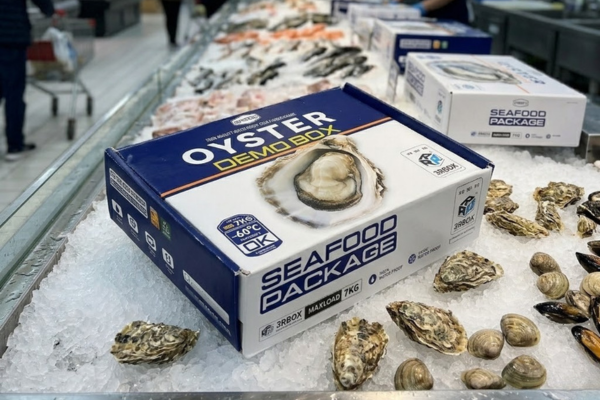
Fish Packaging
Fish packaging should be selected according to the product weight, packing method, temperature, moisture conditions, stacking requirements, and transportation distance.
Important design considerations may include:
- Moisture resistance
- Structural strength
- Stackability
- Internal dimensions
- Easy handling
- Custom printing
- Palletization
Shrimp and Crab Packaging
Shrimp and crab can involve wet handling conditions and relatively high packing densities.
The box structure should therefore be evaluated for:
- Moisture exposure
- Product weight
- Stacking pressure
- Handling
- Cold-chain transportation
Custom dimensions can help businesses better match the packaging to their actual product and loading requirements.
Tuna and Salmon Packaging
Larger seafood products can create higher packaging loads.
For these applications, buyers should consider:
- Product weight
- Number of products per box
- Box dimensions
- Stacking height
- Transportation conditions
- Pallet configuration
The final design should be validated using samples and application-specific testing where necessary.
Innovative Food Packaging Solutions for Fresh Produce
Fresh produce requires a different packaging strategy from seafood.
Fruits and vegetables can be sensitive to mechanical damage, temperature, humidity, airflow, and transportation duration.
Fruit Packaging
Different fruits require different packaging designs.
Examples include:
- Citrus packaging boxes
- Grape packaging boxes
- Tomato boxes
- Plum boxes
- Kiwi packaging
- Blueberry packaging
- Lychee packaging
The packaging design may incorporate ventilation, stacking strength, moisture resistance, and product-specific dimensions.
Vegetable Packaging
Vegetable packaging may need to deal with moisture and repeated handling.
Examples include:
- Broccoli boxes
- Tomato packaging
- Fresh vegetable transport boxes
- Agricultural collection boxes
For wet produce, moisture resistance can be particularly important.
Ventilation Design
Ventilation should be designed according to the product and supply chain.
The basic design principle is:
Airflow should be sufficient for the intended application without unnecessarily compromising box strength.
This is why there is no universal ventilation pattern suitable for every fruit or vegetable.
Cold-Chain Packaging: Where Innovation Becomes Practical
Cold-chain transportation places packaging under conditions that ordinary room-temperature packaging may not experience.
A cold-chain packaging solution may need to deal with:
- Refrigerated storage
- Frozen storage
- Condensation
- Ice
- Moisture
- Compression
- Temperature changes
- Long transportation times
The FDA’s food-contact guidance distinguishes conditions of use including refrigerated and frozen storage, illustrating why packaging intended for different temperature conditions should be evaluated according to its specific use.
Moisture Resistance
Where packaging is exposed to water or condensation, moisture resistance can become an important design requirement.
Compression
Boxes may be stacked for extended periods.
Compression requirements should therefore be determined from actual product weight, stacking height, pallet configuration, and storage conditions.
Temperature
Packaging performance should be assessed at the temperatures expected during the real transportation cycle.
Testing a box only at room temperature may not provide sufficient information for a frozen or refrigerated application.
Container Loading
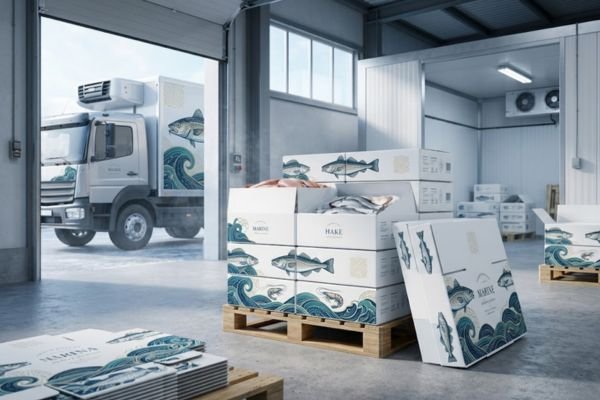
For exporters, packaging innovation should also include logistics.
A box can be redesigned to improve:
- Pallet utilization
- Container loading
- Flat-packed transportation
- Warehouse storage
- Assembly efficiency
This is one of the most practical forms of innovative food packaging solutions because it connects packaging design with the total supply chain.
Stone Paper Corrugated Packaging as an Alternative Food Packaging Option
Stone paper corrugated packaging is one material option that can be evaluated for specific food packaging applications.
Stone paper products are commonly associated with calcium carbonate-based materials rather than conventional wood-pulp paper. The characteristics of a finished corrugated board depend on its formulation, manufacturing process, structure, thickness, and other specifications.
For applications where moisture resistance and durable handling are important, stone paper corrugated packaging can be considered alongside other packaging materials.
Potential applications include:
- Seafood packaging
- Fresh produce packaging
- Cold-chain packaging
- Reusable transport boxes
- Waterproof packaging applications
However, material selection should always be based on actual performance requirements.
A material should not be described as universally better than another material without considering the specific product, transportation conditions, regulatory requirements, recycling infrastructure, and end-of-life pathway.
What Makes Cool Food Packaging Actually Useful?
The term cool food packaging is often associated with attractive graphics, unusual shapes, or creative presentation.
Those elements can certainly help brands differentiate themselves.
But for B2B food packaging, the most useful “cool” features are often practical ones.
A packaging design becomes more interesting when it combines several functions:
- Easy assembly
- Custom printing
- Foldability
- Ventilation
- Moisture resistance
- Stackability
- Reusability
- Product identification
For example, a seafood box that combines a waterproof structure, custom branding, foldable construction, and efficient palletization may be more valuable than a box that simply has an unusual appearance.
The best unique food packaging is therefore not necessarily the most complicated design.
It is the design that solves the right problem.
How to Evaluate Eco-Friendly Food Packaging Ideas
Businesses should be careful when comparing sustainability claims.
A packaging material should not be considered environmentally preferable simply because it is described as “green,” “eco-friendly,” or “sustainable.”
A more objective evaluation can ask:
Is the packaging recyclable?
Recyclability depends on the material, design, collection system, sorting process, and recycling infrastructure available in the target market.
The EU PPWR establishes a framework in which packaging placed on the EU market is subject to recyclability requirements, with further criteria being developed through delegated and implementing acts.
Can it be reused?
Reuse can be advantageous when a practical return system exists.
Does it protect food effectively?
Packaging that fails to protect food can lead to product loss. Product protection therefore belongs in a sustainability discussion.
How efficiently can it be transported?
Packaging dimensions, weight, folding structure, and pallet utilization can influence logistics efficiency.
What happens after use?
End-of-life options should be considered from the beginning of the packaging design process.
This lifecycle perspective provides a more meaningful basis for comparing eco-friendly food packaging ideas.
Food-Contact Compliance: An Important Consideration
Food packaging is not only a design issue.
If packaging is intended to come into direct or indirect contact with food, applicable food-contact regulations need to be considered.
In the United States, FDA describes food-contact substances as substances intended to be used as components of materials for manufacturing, packing, packaging, transporting, or holding food, and authorization depends on the intended use.
In the European Union, food-contact materials must comply with Regulation (EC) No 1935/2004, alongside relevant good manufacturing practices and specific legislation for certain material categories.
This distinction is particularly important for packaging suppliers.
A box designed for secondary or transport packaging should not automatically be described as suitable for direct food contact.
Buyers should confirm:
- Intended use
- Food-contact conditions
- Material composition
- Applicable regulations
- Required testing
- Documentation
This is also why responsible packaging companies should avoid making broad “food safe” claims without supporting documentation.
How to Develop an Innovative Food Packaging Solution
A successful packaging project should start with the application rather than the material.
Step 1: Understand the Product
Identify:
- Product type
- Product dimensions
- Product weight
- Packing method
- Moisture level
- Temperature requirements
Step 2: Understand the Supply Chain
Determine:
- Transportation distance
- Refrigerated or ambient transportation
- Storage conditions
- Stacking height
- Pallet dimensions
- Container requirements
Step 3: Design the Structure
Develop:
- Box dimensions
- Folding structure
- Ventilation
- Reinforcement
- Board thickness
- Printing area
Step 4: Develop the Artwork
Add:
- Logo
- Brand information
- Product information
- Handling instructions
- QR codes
- Other required markings
Step 5: Produce Samples
A prototype allows the buyer to evaluate:
- Dimensions
- Assembly
- Product fit
- Printing
- Handling
- Stacking
Step 6: Conduct Appropriate Testing
Depending on the application, testing may include:
- Compression testing
- Drop testing
- Moisture exposure
- Temperature exposure
- Stacking tests
- Transportation simulation
The appropriate test method should be selected according to the intended application rather than using one universal test for every food product.
Step 7: Optimize Production and Logistics
Before mass production, consider:
- Pallet size
- Flat-packed quantity
- Container loading
- Warehouse storage
- Production quantity
- Delivery schedule
This approach turns a packaging idea into a complete packaging solution.
How to Choose Between Different Food Packaging Options
The right choice depends on what the packaging needs to accomplish.
| Requirement | Key Packaging Consideration |
|---|---|
| Seafood with ice | Moisture/water resistance |
| Fresh produce | Ventilation and product protection |
| Frozen food | Low-temperature application |
| Long-distance export | Strength and logistics |
| Repeated distribution | Reusability |
| Brand differentiation | Custom printing |
| Space-efficient shipping | Foldable structure |
| High stacking | Compression performance |
| Sustainability goals | Lifecycle and end-of-life |
| Direct food contact | Applicable food-contact compliance |
The goal is not to find the “best packaging material” in general.
The goal is to find the right packaging system for a specific application.
Frequently Asked Questions
What is unique food packaging?
Unique food packaging is packaging that uses a distinctive material, structure, format, printing method, or functional design to address a specific product or market requirement. A unique design does not necessarily need to be visually unusual; it can be differentiated through practical performance.
What is innovative food packaging design?
Innovative food packaging design generally refers to packaging that introduces a meaningful improvement in function, efficiency, usability, or environmental performance. The EU’s PPWR provides a formal definition of innovative packaging based on improved packaging functions and demonstrable environmental benefits.
What are some innovative food packaging solutions?
Examples can include foldable boxes, ventilated produce packaging, reusable transport boxes, moisture-resistant packaging, custom structural designs, and packaging systems optimized for pallet and container loading.
The appropriate solution depends on the product and supply-chain requirements.
What is unique plastic packaging?
Unique plastic packaging can refer to plastic packaging with a distinctive structure, application, material combination, printing method, or functional purpose. Corrugated plastic packaging is one example that can be considered for selected wet, reusable, or transport applications.
However, food-contact suitability must be evaluated according to the intended use and applicable regulations.
What are eco-friendly food packaging ideas?
Potential approaches include reusable packaging systems, recyclable packaging, material-efficient structures, lightweight designs, flat-packed packaging, and packaging designed to reduce product damage.
The environmental performance of each option should be evaluated across its lifecycle rather than based only on a marketing label.
What is cool food packaging?
Cool food packaging can refer to packaging with distinctive visual or functional characteristics. For commercial food businesses, the most valuable designs often combine appearance with practical features such as custom printing, foldability, moisture resistance, ventilation, or efficient transportation.
Is stone paper packaging suitable for seafood?
Stone paper corrugated packaging can be evaluated for seafood applications where moisture resistance, structural performance, foldability, and customized packaging are important. Suitability should be confirmed through application-specific sampling and testing.
Can innovative food packaging be customized?
Yes. Customization can include dimensions, box structure, ventilation, printing, folding methods, board specifications, and palletization.
The final design should be based on the product and logistics requirements rather than customization for its own sake.
Conclusion: The Best Food Packaging Solves a Real Problem
The future of food packaging is not simply about making boxes look different.
The more useful direction is to develop packaging that combines function, logistics, product protection, customization, and responsible material use.
For seafood, this may mean moisture-resistant and stackable packaging that can handle demanding distribution conditions.
For fresh produce, it may mean a ventilated structure that balances airflow with strength.
For exporters, it may mean a foldable box that reduces empty packaging volume during transportation.
For brands, it may mean custom printing and distinctive structures that improve product identification.
And for businesses working toward sustainability goals, it may mean evaluating recyclability, reusability, material efficiency, product protection, and end-of-life management together.
This is the difference between packaging that is simply different and packaging that is genuinely useful.
At 3RBOX, we develop customized packaging concepts for seafood, fresh produce, frozen food, and cold-chain applications. Depending on the project requirements, solutions can include customized dimensions, structural design, printing, prototypes, pallet planning, and export packaging.
If you are looking for unique food packaging, innovative food packaging design, or practical innovative food packaging solutions, the best starting point is not a catalog.
It is understanding your product, transportation conditions, stacking requirements, and packaging goals.
Tell us what you need to pack, where it needs to go, and how it will be handled—and we can work from there to develop a packaging solution around the actual application.
