
Fruit packaging plays an important role in protecting fresh produce from harvesting to final delivery. Whether fruits are transported from farms to packing facilities, shipped across international markets, or distributed to supermarkets, the right packaging helps maintain product quality, reduce physical damage, and improve transportation efficiency.
However, not all fruits have the same packaging requirements. Oranges need different protection from blueberries, grapes, avocados, and mangoes. Some fruits require good ventilation, while others need individual cushioning, moisture management, or carefully controlled temperatures.
For fruit exporters, wholesalers, and fresh produce distributors, choosing the right packaging material involves more than comparing box prices. It requires understanding the characteristics of each material, the nature of the fruit, the transportation environment, and the requirements of the destination market.
So, what are the best packaging materials for fruits?
This guide examines six commonly used fruit packaging materials, compares their advantages and limitations, explains how to select packaging for different fruit varieties, and explores the potential of waterproof stone paper corrugated boxes for modern fruit transportation.
1. Why Is Choosing the Right Fruit Packaging Material Important?
Fresh fruits are living biological products. Even after harvesting, they continue to respire and undergo physiological changes that affect their quality, texture, appearance, and shelf life.
During transportation and storage, inappropriate packaging can increase the risk of bruising, compression damage, moisture loss, and other forms of deterioration.
According to the Food and Agriculture Organization of the United Nations (FAO), effective postharvest management aims to maintain product quality, protect food safety, and reduce losses between harvesting and consumption.
Official reference: FAO – Small-Scale Postharvest Handling Practices
Choosing suitable fruit packaging materials is therefore an important part of an effective postharvest management system.
1.1 Protecting Fruits from Physical Damage
Fruits can experience mechanical damage during harvesting, sorting, packing, loading, unloading, and transportation.
Common problems include:
- Bruising caused by impact or excessive pressure.
- Compression damage from excessive stacking.
- Abrasion caused by friction between fruits and packaging surfaces.
- Punctures or cuts caused by rough edges and improper handling.
- Damage caused by excessive movement inside the box.
Different fruits have different levels of sensitivity. Blueberries and ripe strawberries, for example, generally require more careful cushioning than many citrus fruits.
Suitable packaging can help limit unnecessary movement, separate individual fruits, and distribute external pressure more evenly.
For delicate fruits, internal trays, dividers, cushioning pads, and smaller packaging formats may be necessary in addition to the outer shipping box.
1.2 Maintaining Freshness and Quality
Packaging contributes to the physical environment surrounding fresh produce.
Depending on the fruit and packaging design, important factors include:
- Ventilation and airflow.
- Moisture and condensation management.
- Protection against excessive water loss.
- Temperature management during transportation.
- Prevention of contamination during handling.
Ventilation is particularly important when fruits are transported in refrigerated containers or stored in cold rooms. Packaging openings must be designed so that cooling air can circulate through the load.
However, more ventilation is not always better. Excessive openings can weaken the box or increase moisture loss under certain conditions.
The appropriate design depends on the fruit variety, storage requirements, packaging configuration, and transportation environment.
1.3 Improving Transportation and Storage Efficiency
Packaging dimensions and structural design directly influence how efficiently products can be stored and transported.
For exporters, important considerations include:
- Box dimensions and internal capacity.
- Maximum recommended stacking height.
- Pallet dimensions and loading patterns.
- Empty-box storage requirements.
- Container utilization.
- Handling and assembly time.
Well-designed packaging should protect the fruit while making efficient use of available space.
For example, flat-packed boxes can reduce the storage space required before assembly compared with fully assembled containers of similar design.
This can be particularly relevant for exporters shipping large quantities of fresh produce internationally.
1.4 Supporting More Sustainable Packaging Practices
Environmental considerations are becoming an important part of packaging procurement.
Fruit exporters and retailers increasingly evaluate packaging according to material use, durability, transportation requirements, reuse potential, and end-of-life management.
However, a material should not be considered environmentally superior simply because it is described as natural, recyclable, biodegradable, or eco-friendly.
Its actual environmental performance depends on its composition, manufacturing process, transportation, useful life, and available waste management infrastructure.
The European Union’s Packaging and Packaging Waste Regulation, Regulation (EU) 2025/40, establishes requirements addressing packaging sustainability throughout its life cycle.
Official reference: EUR-Lex – Regulation (EU) 2025/40: Packaging and Packaging Waste
For exporters supplying international markets, packaging selection should consider both product protection and the applicable environmental requirements in the destination country.
2. What Are the Most Common Materials Used for Fruit Packaging?
Several materials are commonly used in the fresh produce industry. Each offers different characteristics, making it suitable for particular fruits, distribution systems, and packaging applications.
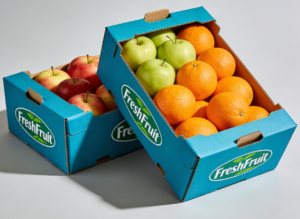
2.1 Corrugated Cardboard Boxes
Corrugated cardboard is one of the most established materials for transporting fresh fruits.
It is commonly used for export cartons, wholesale distribution, supermarket deliveries, and agricultural packaging.
Corrugated board consists of one or more fluted paper layers combined with linerboards. The fluted structure provides rigidity and helps the finished box resist compression and handling forces.
Main advantages:
- Lightweight and relatively easy to handle.
- Available in different board grades and flute configurations.
- Suitable for customized dimensions and printing.
- Can be supplied flat-packed.
- Compatible with a wide range of internal dividers and trays.
Potential limitations:
- Ordinary paper-based board can lose strength when exposed to moisture.
- Compression performance depends on board grade, box geometry, and humidity.
- Protective coatings may affect recycling options.
- Damaged or contaminated cartons may not be accepted by local recycling programs.
Corrugated cardboard is widely used for oranges, apples, pears, grapes, mangoes, and many other fruits.
Its suitability depends on the required stacking strength, moisture exposure, ventilation, and transportation conditions.
For exporters shipping fruit in refrigerated containers, the box design should also allow sufficient airflow through the packaging and palletized load.
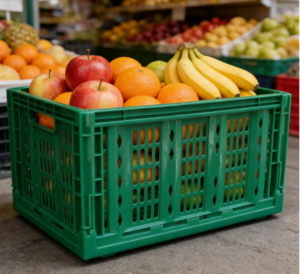
2.2 Plastic Fruit Crates (PP and HDPE)
Plastic crates made from polypropylene (PP) or high-density polyethylene (HDPE) are commonly used in fruit harvesting, sorting, storage, and distribution.
Unlike single-use shipping cartons, many plastic crates are designed for repeated handling and return logistics.
Main advantages:
- Good resistance to water and moisture.
- Suitable for repeated handling when properly designed.
- Can be manufactured with ventilation openings.
- Available in different sizes and stacking configurations.
- Can be cleaned according to appropriate hygiene procedures.
Potential limitations:
- Higher initial purchasing costs in some applications.
- Empty crates may occupy considerable storage space.
- Return transportation can increase logistics costs.
- Cleaning and sanitation must be managed.
- Repeated-use performance depends on material quality and handling conditions.
Plastic crates are frequently used for harvesting and transporting citrus fruits, apples, vegetables, and other agricultural products.
For businesses operating closed-loop distribution systems, reusable crates can be practical because containers can be returned, cleaned, inspected, and used again.
However, the economic and environmental benefits depend on the number of successful reuse cycles, return distances, cleaning requirements, and loss rates.
2.3 Molded Pulp Packaging
Molded pulp packaging is manufactured from fibrous materials formed into specific shapes.
It is particularly useful for protecting individual fruits or separating products inside larger shipping cartons.
Main advantages:
- Can be molded into fruit-specific shapes.
- Helps separate individual fruits.
- Provides cushioning against certain impacts.
- Can be combined with corrugated shipping cartons.
- Suitable for retail presentation and protective inserts.

Potential limitations:
- Moisture resistance depends on the fiber composition and surface treatment.
- Structural performance can change under humid conditions.
- Custom molds may increase initial tooling costs.
- The finished product’s recycling suitability depends on coatings and additives.
Molded pulp trays are commonly used for apples, pears, and other fruits that benefit from individual separation.
For delicate fruits, correctly designed molded trays can help prevent direct contact and reduce movement inside the package.
2.4 Wooden Fruit Crates
Wooden crates have a long history in agricultural transportation.
They can provide structural support for certain bulk fruit applications and may be suitable for specific distribution systems.
Main advantages:
- Can provide substantial structural strength.
- Suitable for certain heavy-duty transport applications.
- Can be manufactured in different sizes.
- May be reused depending on construction and condition.
Potential limitations:
- Generally heavier than many alternative packaging formats.
- Can require more storage space.
- Wood quality and moisture conditions can affect performance.
- International shipments may require phytosanitary compliance.
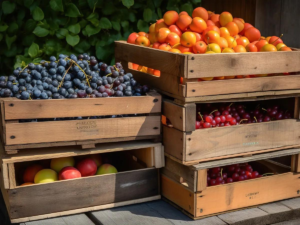
An important consideration for exporters is ISPM 15, the International Standard for Phytosanitary Measures covering wood packaging material in international trade.
The standard establishes measures to reduce the risk of introducing and spreading quarantine pests through regulated wood packaging materials.
It covers items such as wooden pallets, crates, boxes, and dunnage, subject to the standard’s scope and exemptions.
Official reference: IPPC – Regulation of Wood Packaging Material in International Trade (ISPM 15)
Exporters using regulated wooden packaging should confirm the treatment and marking requirements applicable to the destination market.
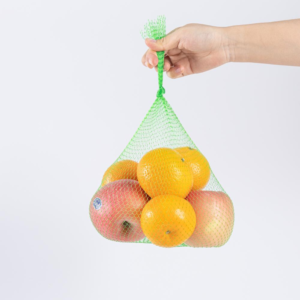
2.5 Flexible Plastic Films and Mesh Bags
Flexible plastic packaging includes produce bags, stretch films, perforated films, and mesh bags.
These materials are commonly used for retail packaging and selected distribution applications.
Main advantages:
- Lightweight and flexible.
- Can provide visibility of the packaged fruit.
- Available in different thicknesses and formats.
- Perforations can be designed to support ventilation.
- Suitable for individual retail portions and small produce packs.
Potential limitations:
- Limited mechanical protection compared with rigid containers.
- May require an outer carton or crate.
- Film permeability must be matched to the fruit’s respiration characteristics.
- Condensation and moisture accumulation need to be considered.
- Disposal and recycling depend on material composition and local collection systems.
Some fresh produce packaging systems use modified atmosphere packaging (MAP).
MAP works by controlling the atmosphere inside a package through the interaction between produce respiration and the gas permeability of the packaging film.
However, the appropriate film properties depend on the specific fruit, temperature, respiration rate, and package configuration.
It is not a universal solution for all fruits.
2.6 Stone Paper Corrugated Boxes
Stone paper corrugated boxes are another material option worth evaluating for fresh produce transportation.
Stone paper generally refers to a material made primarily from mineral filler, commonly calcium carbonate, combined with a polymeric binder. The exact formulation and production process vary between manufacturers.
When converted into corrugated or structured packaging, the material can be designed for different box sizes, folding configurations, and printing requirements.
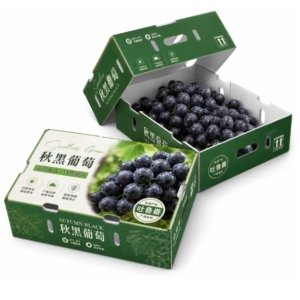
For fruit exporters, potential characteristics to evaluate include:
Water and moisture resistance
Certain stone paper board formulations offer resistance to water and moisture. This can be relevant in humid storage environments, refrigerated distribution, and situations where packaging may encounter condensation.
Structural durability
The finished box can be designed with different board weights, thicknesses, and structural configurations. Compression and stacking performance must be verified for each specification.
Customizable designs
Ventilation holes, folding structures, printed logos, and customized dimensions can be incorporated according to the packaging requirements.
Flat-packed transportation
Foldable designs can be supplied in flat form, potentially reducing the space occupied by empty packaging before assembly.
Potential for repeated use
Depending on the board specification and finished-box construction, repeated use may be possible. Actual reuse performance should be established through durability and hygiene testing.
Stone paper corrugated boxes should not be assumed to provide the same thermal insulation as EPS or other dedicated insulated packaging. Their suitability for fresh produce depends on the fruit, the cooling system, the box design, and the transportation conditions.
For exporters looking for alternatives to conventional fruit shipping cartons, this material provides another option to evaluate.
Explore 3RBOX fruit packaging boxes for customized packaging applications.
3. Comparison of Different Fruit Packaging Materials
Choosing the best fruit packaging material requires looking at more than one performance characteristic.
The following table summarizes the general characteristics of six commonly used packaging options.
| Material | Moisture Resistance | Protection | Reuse Potential | Typical Applications |
|---|---|---|---|---|
| Corrugated cardboard | Limited without protective treatment | Good when properly designed | Conditional | Export cartons and wholesale |
| PP/HDPE plastic crates | Generally high | Good structural protection | High potential | Harvesting and distribution |
| Molded pulp | Depends on formulation | Good for individual fruit cushioning | Conditional | Fruit trays and inserts |
| Wooden crates | Depends on construction | Good structural support | Conditional | Bulk agricultural transport |
| Flexible plastic films | Depends on film properties | Limited physical protection | Usually limited | Retail fruit packaging |
| Stone paper corrugated board | Depends on formulation and design | Requires structural validation | Requires testing | Customized fruit shipping boxes |
These descriptions are general material characteristics rather than guaranteed performance ratings. Specific grades, manufacturing processes, and package designs can produce significantly different results.
A suitable packaging decision should therefore be based on actual product specifications and representative testing.
4. How to Choose the Best Packaging Material for Different Fruits?
One of the most important principles in fruit packaging is that different fruits have different postharvest requirements.
A packaging system that works well for oranges may not be suitable for blueberries or strawberries.
The fruit’s size, skin structure, firmness, respiration characteristics, sensitivity to pressure, and storage conditions should all influence packaging design.
4.1 Packaging for Citrus Fruits
Citrus fruits include oranges, mandarins, lemons, limes, and other varieties.
They are commonly transported in cartons or reusable crates, depending on the distribution system.
Key packaging requirements:
- Adequate stacking strength.
- Suitable ventilation.
- Protection against compression and abrasion.
- Appropriate moisture management.
- Efficient carton dimensions.
Citrus fruits are generally more resistant to handling than delicate berries, but they can still suffer from impact damage, pressure injuries, and skin deterioration.
For export transportation, corrugated cartons with appropriately designed ventilation openings are commonly used.
Stone paper corrugated boxes may also be evaluated for citrus packaging where moisture resistance, customized printing, and flat-packed delivery are important.
The ventilation pattern should be designed around the fruit size, packing method, and cooling requirements rather than selected purely for appearance.
4.2 Packaging for Grapes
Grapes are relatively delicate and can be damaged by excessive pressure, movement, or poor handling.
They are commonly packed in small retail containers or trays, which are then placed inside larger corrugated shipping cartons.
Key packaging requirements:
- Protection against compression.
- Proper ventilation.
- Suitable internal separation.
- Moisture management.
- Compatibility with cold-chain distribution.
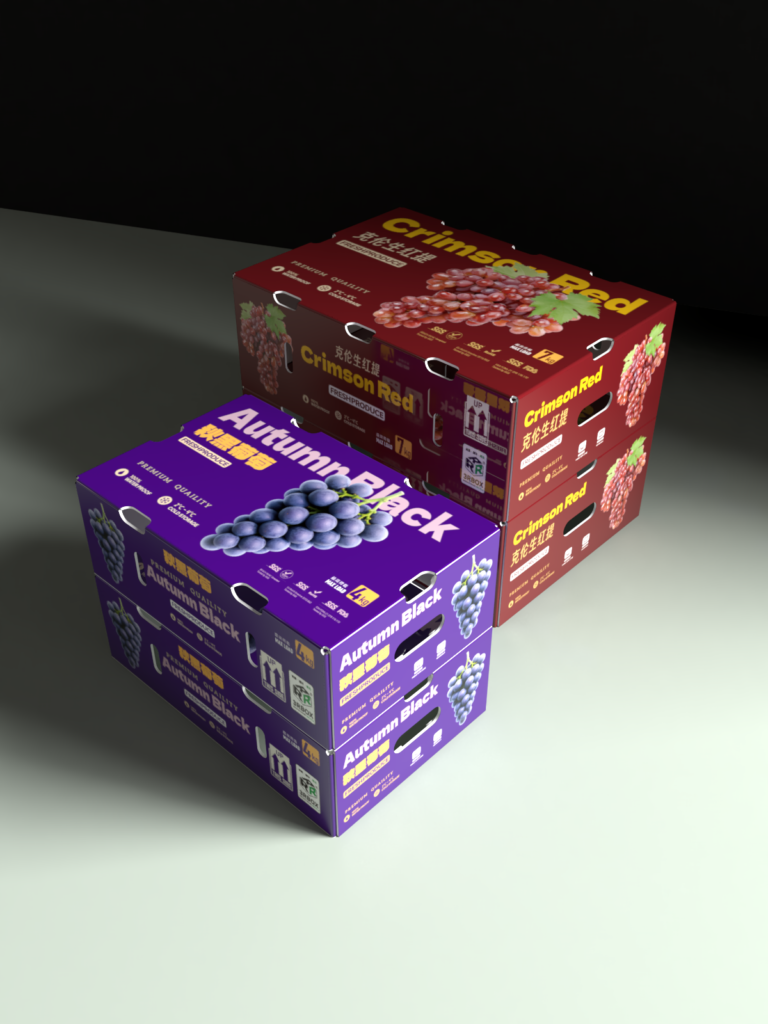
The packaging should prevent excessive movement while avoiding unnecessary pressure on the grape clusters.
For export cartons, the design must also allow sufficient airflow through the packed load.
The final configuration should be tested under the intended storage and transportation conditions.
4.3 Packaging for Blueberries and Strawberries
Blueberries and strawberries require careful packaging because their surfaces and structures are sensitive to mechanical damage.
Small retail containers, trays, and protective outer cartons are commonly used.
Key packaging requirements:
- Protection against impact and compression.
- Suitable ventilation.
- Controlled moisture conditions.
- Prevention of excessive movement.
- Stable temperature management.
For strawberries, the package should help reduce crushing and contact damage.
Blueberries are commonly packed in small rigid retail containers, often with ventilation features, before being placed into larger shipping cartons.
A larger outer box should support the smaller containers without applying excessive pressure to the fruit.
Packaging design alone cannot prevent spoilage. Proper pre-cooling, temperature management, handling, and sanitation remain essential.
4.4 Packaging for Avocados and Mangoes
Avocados and mangoes are widely traded internationally and are often transported through multi-stage distribution networks.
Both fruits can be vulnerable to bruising and compression damage, particularly when they are harvested or transported at different maturity stages.
Key packaging requirements:
- Sufficient structural strength.
- Protection against impact and pressure.
- Appropriate internal spacing.
- Ventilation compatible with the cooling system.
- Temperature management according to fruit maturity and variety.
Individual dividers or molded inserts may be useful for certain sizes and distribution requirements.
For larger export cartons, packaging dimensions should be designed around the fruit’s size, packing orientation, gross weight, and stacking configuration.
The required storage temperature should be determined according to the specific fruit variety and maturity stage, since some tropical fruits are sensitive to chilling injury.
4.5 Packaging for Apples and Pears
Apples and pears are commonly distributed in bulk cartons, trays, and other protective packaging systems.
Depending on the variety and destination market, they may be transported through refrigerated storage and distribution networks.
Key packaging requirements:
- Reliable compression strength.
- Protection against abrasion.
- Appropriate internal separation.
- Good stacking stability.
- Compatibility with refrigerated storage.
Internal trays can help separate individual fruits and reduce movement.
The outer carton should be strong enough to support the intended stacking load throughout storage and transportation.
For longer distribution routes, the complete packaging and cooling system should be evaluated together.
5. What Factors Should Fruit Exporters Consider When Choosing Packaging?
Selecting fruit packaging materials for international transportation requires a systematic evaluation of both product requirements and logistics conditions.
5.1 Ventilation and Airflow Design
Ventilation is one of the most important considerations in fresh produce packaging.
Fresh fruits continue to respire after harvesting. During storage and transportation, heat and gases generated by the produce need to be managed through appropriate postharvest practices and cooling systems.
Ventilation openings can help refrigerated air move through the packaging and around the produce.
However, ventilation holes should be carefully positioned.
Poorly designed openings may weaken the carton, reduce compression performance, or become blocked by internal liners and packaging materials.
According to the University of California Agriculture and Natural Resources (UC ANR), postharvest packaging recommendations include using sturdy packages, avoiding excessive package sizes, and ensuring that ventilation openings remain unobstructed.
Reference: UC ANR – Small-Scale Postharvest Handling Practices
For customized fruit boxes, ventilation design should consider:
- Fruit variety and size.
- Cooling method.
- Box dimensions.
- Stacking configuration.
- Refrigerated transportation conditions.
A good ventilation design balances airflow requirements with structural strength.
5.2 Moisture and Water Resistance
Fresh produce packaging may be exposed to high humidity, condensation, and occasional water contact.
These conditions can influence the strength and stability of packaging materials.
Paper-based cartons, for example, can experience reduced compression performance when moisture absorption weakens the board structure.
Plastic crates and certain coated or polymer-based packaging materials may provide greater resistance to moisture, depending on their design.
For stone paper corrugated boxes, buyers should evaluate the actual moisture resistance of the board and finished package, including joints, closures, and printed surfaces.
It is also important to distinguish between moisture resistance and liquid containment. A water-resistant board does not automatically make the entire box leakproof.
5.3 Compression Strength and Stackability
During export transportation, fruit boxes are often stacked on pallets and loaded into refrigerated containers.
The lower cartons must support the weight of the cartons above them.
Insufficient compression strength can result in collapsed boxes, damaged fruit, and inefficient cargo handling.
Before selecting a packaging material, exporters should determine:
- Gross weight per box.
- Number of stacking layers.
- Expected storage duration.
- Pallet configuration.
- Transportation vibration and handling conditions.
Compression testing and actual stacking trials can help establish whether a packaging design is suitable.
The box material alone does not determine stacking strength. Board thickness, structural geometry, corner design, ventilation openings, and moisture conditions also matter.
5.4 Packaging Size and Container Loading Efficiency
Packaging dimensions have a direct influence on export logistics costs.
A fruit box should provide sufficient internal space without unnecessary empty volume.
For exporters shipping large quantities, small improvements in box dimensions and pallet arrangements may influence the total number of units that can be loaded into a shipping container.
Important considerations include:
- Internal and external box dimensions.
- Pallet size.
- Maximum usable loading height.
- Box orientation.
- Flat-packed or assembled delivery.
- Container payload and volume limitations.
For example, a customized flat-packed box may allow more empty packaging to be transported in one shipment than an equivalent fully assembled box.
However, the actual improvement must be calculated using the final box dimensions, pallet design, stacking method, and container specifications.
For large-volume buyers, packaging suppliers should ideally assist with pallet planning and container loading calculations before bulk production.
5.5 Food Safety and Regulatory Compliance
Fruit packaging must be appropriate for its intended use.
Some packaging components directly contact fruits, while others function only as secondary transport packaging.
These applications may have different regulatory requirements.
Exporters should request appropriate documentation for materials, inks, coatings, adhesives, and other components that may come into contact with food.
For the European market, Regulation (EC) No 1935/2004 provides the general framework for materials and articles intended to come into contact with food.
Official reference: EUR-Lex – Regulation (EC) No 1935/2004
For the United States, the FDA provides guidance on determining the regulatory status of food-contact material components.
Official reference: FDA – Determining the Regulatory Status of Components of a Food Contact Material
Buyers should not assume that a packaging material is suitable for direct food contact without the relevant supporting documentation.
5.6 Total Packaging Cost
The purchase price per box is only one part of the total packaging cost.
For fruit exporters, the overall cost may include:
- Material and manufacturing costs.
- Printing and customization.
- Storage before use.
- Freight and container utilization.
- Assembly and packing labor.
- Product damage and packaging failures.
- Cleaning and return logistics for reusable containers.
- Waste collection and disposal.
A packaging system with a lower unit price may not necessarily offer the lowest total cost.
For this reason, exporters should compare different packaging solutions based on the total cost per shipment or per unit of fruit delivered in acceptable condition.
6. Why Consider Stone Paper Corrugated Boxes for Fruit Packaging?
As fresh produce businesses explore different packaging options, stone paper corrugated boxes provide another material format worth evaluating.
They are particularly relevant to applications where moisture resistance, customized structures, and efficient empty-box transportation are important considerations.
For 3RBOX, the focus is on developing customized stone paper corrugated packaging for fruit and fresh produce transportation.
6.1 Waterproof and Moisture-Resistant Properties
Moisture exposure is a common challenge in fruit distribution.
High humidity, condensation, and refrigerated storage can affect the performance of conventional paper-based cartons.
Depending on the formulation and board specification, stone paper materials can provide resistance to water and moisture.
This characteristic may be useful for selected fruit transportation environments, including refrigerated storage and humid distribution conditions.
However, buyers should distinguish between board-level water resistance and finished-box performance.
Testing should examine the actual box, including its folds, joints, closures, and structural strength after moisture exposure.
6.2 Customizable Ventilation and Box Structures
Different fruits require different packaging configurations.
For example, citrus fruit boxes may need a different ventilation pattern from grape or avocado cartons.
Stone paper corrugated boxes can be designed with customized dimensions, folding structures, and ventilation openings according to the intended application.
Possible customization options include:
- Different box dimensions and capacities.
- Customized ventilation holes.
- Folding and locking structures.
- Printed logos and product information.
- Different board weights and thicknesses.
The final structure should balance airflow, protection, stacking performance, and ease of assembly.
6.3 Flat-Packed Delivery and Transportation Efficiency
Flat-packed packaging can offer advantages for businesses transporting large quantities of empty boxes.
Instead of shipping fully assembled containers, suitable folding designs can be supplied in a flat configuration.
Potential operational benefits include:
- Reduced storage space before use.
- More convenient warehouse organization.
- Improved transportation efficiency for empty packaging.
- Easier inventory management.
- More flexible distribution to packing facilities.
For fruit exporters, the actual benefit depends on the flat-packed dimensions, pallet configuration, assembly requirements, and container loading plan.
6.4 Custom Printing and Branding
Packaging also serves as a communication tool between producers, exporters, distributors, and buyers.
Customized printing can help identify the fruit variety, brand, origin, product specifications, and handling information.
For fruit wholesalers and exporters, branded shipping cartons can also improve product presentation when boxes are displayed in wholesale markets or retail distribution environments.
Stone paper corrugated boxes can be evaluated for customized printing according to the material’s printing compatibility and the selected production process.
6.5 Reusable Packaging Potential
Packaging reuse is another consideration for businesses seeking to improve resource efficiency.
A durable packaging structure may be suitable for repeated use if it retains its required strength and hygiene characteristics after handling.
However, reuse should not be assumed based on material composition alone.
The number of practical reuse cycles depends on:
- Structural durability.
- Exposure to moisture and handling impacts.
- Cleaning requirements.
- Storage conditions.
- Damage and inspection procedures.
For fruit transportation, buyers should conduct repeated-use testing before introducing a reusable packaging program.
Learn more about 3RBOX fruit packaging solutions and fresh produce packaging.
7. How to Select a Reliable Fruit Packaging Supplier?
Choosing the right packaging supplier is just as important as selecting the material.
A supplier should understand not only packaging production but also the operational requirements of the fruit distribution industry.
Here are several important factors to evaluate.
7.1 Material Knowledge and Product Specifications
A professional supplier should be able to explain the material composition, board specifications, available thicknesses, and structural options.
Buyers should request technical information relevant to the intended packaging application.
7.2 Custom Design and Sampling Capabilities
Fruit packaging often requires customized dimensions and ventilation designs.
A supplier should be able to review existing packaging samples, understand the fruit’s requirements, and develop suitable box structures.
Sample production is important because it allows buyers to evaluate dimensions, assembly, printing, and practical handling before bulk orders.
7.3 Testing and Quality Control
Ask whether the supplier can provide relevant test reports or support testing for:
- Compression strength.
- Moisture resistance.
- Structural durability.
- Low-temperature performance, where applicable.
- Food-contact compliance, where required.
Testing should be relevant to the final packaging specification rather than relying on general material claims.
7.4 Export Logistics and Pallet Planning
For international buyers, packaging suppliers should understand export transportation requirements.
The ability to calculate pallet quantities, flat-packed loading configurations, and container capacity can help buyers evaluate the overall logistics cost.
7.5 Stable Production and Communication
Large-volume fruit packaging orders often involve customized designs, printing approvals, sampling, and production schedules.
Reliable communication and consistent quality control are important for maintaining supply-chain stability.
8. Frequently Asked Questions About Fruit Packaging Materials
What is the best material for fruit packaging?
There is no single best material for all fruits. Corrugated cardboard is widely used for export cartons, plastic crates are suitable for many reusable distribution systems, molded pulp provides individual fruit protection, and flexible films are common in retail packaging. The best choice depends on the fruit variety, transportation conditions, protection requirements, and cost.
Which packaging material keeps fruits fresh longer?
Packaging material alone does not determine fruit freshness. Freshness depends on factors such as harvesting maturity, pre-cooling, temperature, relative humidity, ventilation, and postharvest handling. Suitable packaging helps protect the fruit and supports the required storage environment.
Are cardboard boxes suitable for fruit export?
Yes. Corrugated cardboard boxes are widely used for international fruit transportation. Their suitability depends on board grade, compression strength, ventilation, moisture exposure, and the intended stacking configuration.
What is the best packaging for fresh produce?
The appropriate packaging depends on the type of produce. Delicate berries may require small rigid containers and protective trays, while citrus fruits and apples are often shipped in corrugated cartons or reusable crates. Packaging should be selected according to the product’s physical and postharvest requirements.
Are waterproof fruit packaging boxes better than traditional cardboard boxes?
Water-resistant packaging can be useful in humid environments and refrigerated distribution. However, waterproof performance is only one consideration. Buyers should also evaluate compression strength, ventilation, cost, weight, recycling options, and the complete package design.
What packaging is commonly used for citrus fruits?
Citrus fruits are commonly packed in corrugated cartons and reusable plastic crates. Packaging selection depends on fruit size, weight, stacking requirements, ventilation, and the distribution system.
How can fruit exporters reduce packaging costs?
Exporters can review packaging dimensions, material specifications, pallet arrangements, and container loading efficiency. Flat-packed boxes may also reduce the space needed for empty packaging. A complete cost comparison should include purchase price, freight, storage, assembly, and product damage.
Are stone paper corrugated boxes suitable for fresh produce?
They may be suitable for selected fresh produce applications, depending on the material formulation, box design, moisture resistance, and structural performance. Buyers should test the finished packaging under their actual storage and transportation conditions before placing bulk orders.
Why are ventilation holes important in fruit packaging?
Ventilation openings help facilitate airflow through packages, which is important in many refrigerated produce distribution systems. Their size and position should be designed to support cooling while maintaining sufficient box strength.
What should I consider when choosing a fruit packaging supplier?
Consider the supplier’s material knowledge, customization capabilities, sample development, quality testing, production consistency, and export logistics support. A supplier that understands both fruit handling and packaging design can help develop a more suitable solution.
9. Conclusion: Choosing the Right Material for Fruit Packaging
The best packaging materials for fruits depend on the type of fruit, its sensitivity to physical damage, storage requirements, transportation conditions, and the expectations of the destination market.
Corrugated cardboard remains a widely used option for fruit export cartons. Plastic crates offer practical advantages for reusable distribution systems, while molded pulp provides additional protection for individual fruits. Flexible films and mesh bags are suitable for selected retail applications, and wooden crates continue to serve certain agricultural transportation needs.
Stone paper corrugated boxes offer another option for businesses evaluating moisture-resistant, customized, and flat-packed fruit packaging.
However, no material should be selected based on a single feature. Packaging performance, food safety, ventilation, stacking strength, transportation efficiency, and end-of-life management should all be considered.
For fruit exporters and wholesalers, the most effective approach is to match the packaging structure to the specific fruit and supply-chain requirements, then validate the design through samples and practical testing.
Looking for customized fruit packaging solutions?
3RBOX provides customized packaging solutions for fresh produce applications, including fruit packaging boxes, waterproof stone paper corrugated packaging, and tailored box structures.
Whether you are transporting oranges, grapes, avocados, mangoes, or other fresh produce, our team can help evaluate packaging dimensions, ventilation requirements, printing options, and flat-packed shipping configurations.
Contact 3RBOX to discuss your fruit packaging requirements and explore a customized solution for your export business.
