
Introduction
Choosing the right packaging supplier involves much more than comparing prices. For importers, seafood exporters, fresh produce companies, and food manufacturers, understanding minimum order quantities, printing options, shipping methods, and export requirements is essential before placing an order.
Stone paper boxes have become an increasingly popular packaging solution for cold chain logistics because they combine water resistance, durability, and printability in one material. Compared with conventional corrugated paper boxes, they are designed to perform better in humid and refrigerated environments where moisture can reduce the strength of traditional paper packaging.
This guide explains everything international buyers should know before ordering stone paper boxes, including MOQ, customization, printing technologies, production lead time, shipping methods, and export considerations.
What Are Stone Paper Boxes?
Stone paper boxes are packaging products manufactured from stone paper corrugated board. Stone paper is a composite material made primarily from calcium carbonate (CaCO₃) with a smaller proportion of polymer resin acting as a binder. Unlike conventional paper, it contains no wood pulp.
Because of their material structure, stone paper boxes offer several practical advantages for cold-chain packaging:
- Water-resistant surface
- High compressive strength
- Excellent moisture resistance
- Suitable for refrigerated and frozen logistics
- Smooth printing surface
- Recyclable in recycling systems that accept the resin used in the product
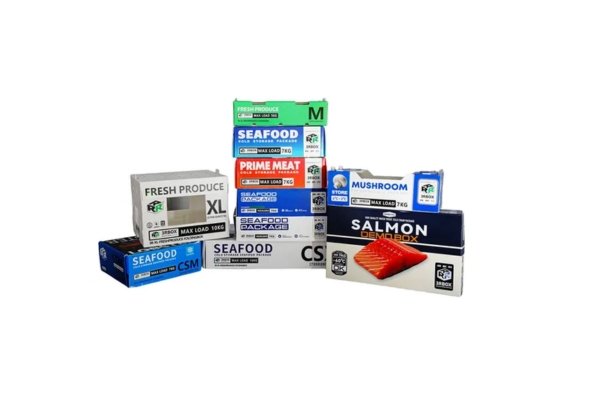
These characteristics make stone paper boxes widely used for:
- Seafood packaging
- Fish packaging
- Fruit packaging
- Frozen food packaging
- Agricultural exports
- Cold chain transportation
What Is the Typical MOQ for Stone Paper Boxes?
One of the first questions buyers ask is:
What is the minimum order quantity (MOQ)?
The answer depends on several production factors rather than one universal number.
Typical MOQ is influenced by:
Box Size
Larger boxes consume more material and production capacity.
Printing Requirements
Plain boxes generally require a lower MOQ than custom-printed packaging because the printing setup involves additional preparation.
Structural Design
Standard Regular Slotted Containers (RSC) usually require smaller production runs than complex custom structures.
Manufacturing Process
If custom cutting dies or printing plates must be produced, suppliers often recommend higher order quantities to spread tooling costs.
For export orders, many manufacturers recommend producing enough boxes to optimize container loading and reduce per-unit shipping costs.
Tip for buyers
If this is your first order, ask whether the manufacturer can provide samples or conduct a pilot production before mass manufacturing.
Can Stone Paper Boxes Be Customized?
Yes.
Most professional manufacturers provide OEM and ODM services.
Common customization options include:
Custom Dimensions
Boxes can be manufactured according to:
- Product dimensions
- Pallet configuration
- Container optimization
- Cold chain logistics requirements
Box Structures
Available designs may include:
- Regular slotted boxes
- Folding boxes
- Top and bottom boxes
- Ventilated fruit boxes
- Seafood transport boxes
- Stackable export cartons
Ventilation Design
Fresh produce packaging often includes ventilation holes that improve airflow during transportation.
The position and size of vents should be determined according to the transported product and logistics conditions.
Printing Options for Stone Paper Boxes
Printing quality directly affects brand image, especially for food exporters.
Stone paper has a smooth surface that supports high-quality graphics.
Common printing options include:
Flexographic Printing
Suitable for:
- Large production runs
- Simple graphics
- One to four colors
Advantages:
- Cost-effective
- Fast production
- Common for transport packaging
Offset Printing
Recommended for:
- Premium packaging
- High-resolution images
- Retail-ready boxes
Advantages:
- Excellent color consistency
- Sharp text
- Fine graphic details
UV Printing
UV printing provides:
- Bright colors
- Scratch resistance
- Fast curing
- High-quality appearance
It is commonly selected for premium branding.
Custom Logo Printing
Most manufacturers can print:
- Company logo
- Product information
- QR codes
- Barcodes
- Shipping marks
- Handling instructions
Artwork is typically supplied as vector files such as AI, PDF, or EPS to ensure accurate reproduction.
How Long Does Production Take?
Production lead time depends on:
- Order quantity
- Printing complexity
- Material availability
- Factory production schedule
For custom export orders, buyers should also allow time for:
- Artwork approval
- Sample confirmation
- Quality inspection
- Export packaging
- International transportation
Planning orders well before the shipping date helps reduce the risk of supply chain delays.
Shipping Options for International Buyers
Most stone paper boxes are shipped flat-packed.
Flat packing offers several advantages:
- Lower transportation costs
- Higher container utilization
- Reduced warehouse space
- Easier inventory management
Common shipping methods include:
Sea Freight
Best for:
- Large export orders
- Full Container Load (FCL)
- Less than Container Load (LCL)
Sea freight is generally the most economical solution for international shipments.
Air Freight
Suitable for:
- Urgent orders
- Sample shipments
- Small quantities
Although faster, air freight usually has a higher transportation cost.
Rail Transport
For some regions, rail transport provides an alternative that balances transit time and shipping cost.
Export Considerations
International buyers should confirm several details before placing an order.
Packaging Requirements
Export packaging should adequately protect products during:
- Loading
- Ocean transportation
- Warehousing
- Distribution
Proper palletization and protective wrapping can reduce the risk of transport damage.
Labeling Requirements
Depending on the destination market, export cartons may require:
- Product identification
- Country of origin
- Batch numbers
- Handling symbols
- Customer-specific shipping labels
Always verify destination-country regulations before shipment.
Documentation
Common export documents include:
- Commercial Invoice
- Packing List
- Bill of Lading or Air Waybill
- Certificate of Origin (when required)
Document requirements vary by destination and trade terms.
How to Choose a Reliable Stone Paper Box Manufacturer
When evaluating suppliers, consider more than price.
Look for manufacturers that offer:
- Stable production capacity
- Consistent quality control
- Export experience
- Custom engineering support
- Professional communication
- Sample evaluation before mass production
It is also beneficial to review previous export projects involving seafood, fresh produce, or frozen food packaging, as these applications often require packaging that performs reliably in cold and humid logistics environments.
Frequently Asked Questions
Are stone paper boxes waterproof?
Stone paper packaging is highly resistant to water and moisture because the material does not absorb water as readily as conventional paper.
Can stone paper boxes be recycled?
Recyclability depends on the local recycling infrastructure and the resin used in the product. Buyers should consult local recycling regulations and the manufacturer’s material specifications.
Can I print my company logo?
Yes. Most manufacturers offer custom logo printing using flexographic, offset, or UV printing technologies.
Are stone paper boxes suitable for frozen seafood?
Yes. Their moisture resistance and structural durability make them suitable for many refrigerated and frozen food logistics applications.
Conclusion
Selecting the right stone paper boxes involves evaluating far more than unit price. Buyers should consider MOQ, customization options, printing methods, shipping efficiency, export requirements, and supplier experience before making a purchasing decision.
Working with an experienced manufacturer can help reduce packaging costs, improve logistics efficiency, and support reliable product protection throughout international cold chain transportation. Whether you export seafood, fresh fruit, vegetables, or frozen foods, understanding these factors will help you choose packaging that aligns with your operational and branding goals.
